
Posted on April 7, 2019
Japanese Politics: Political archetype (Pt. 4)
Previously in Part 2, we used the traditional political left-right-wing model to differentiate major contrasting policies. This post will describe main archetype of party which may not exist in current Japanese politics, however, it give a better understanding of different variety of parties between the spectrum.
Archetype of political party:
I will start from parties from the far left of the spectrum and transition towards the far right.
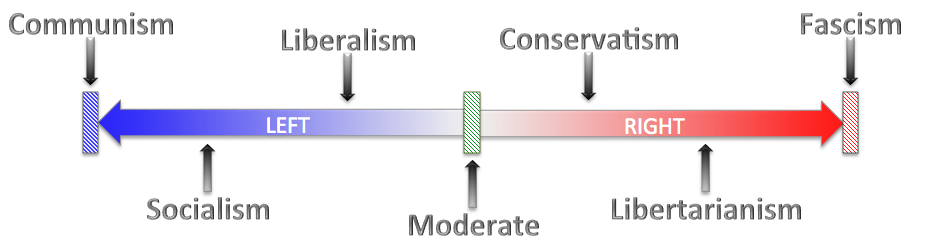
Communism:
- Promote equality and everyone works towards the same goal. Therefore no wealthy individual and thereby social class is eliminated.
- Opposite to capitalism
- Government carries out wealth redistribution equally
- Working class owns everything (although usually it ends up being own by government)
- As no wealth can be obtain, society becomes not motivated to improve market thereby it is common to country to have low production, mass poverty and limited advancement.
- Centralise nature result to lack from freedom to protest let alone change the political system
- E.g. Maoism in China
Socialism:
- A system of collective ownership and management of production and distribution of goods. Aim for equality between all, cooperating for common good of all.
- Similarly to Communism in the sense socialist aim for equality but as not extreme
- However production is owned by Government.
- Workers receive what they need to produce and survive
- Little incentive for people to achieve
- Some countries adopted “some” aspect of socialism into their system such as UK provide basic healthcare for everyone.
Democratic socialism:
- Share the same principle of equality in socialism but attain within a democratic state (ensure free from oppression via legal mechanism)
- Socialism in terms of ownership of production, implement excessive taxes and support redistribution policies.
- Reject the perceived authoritarian for of governance and fights dictatorship
- Best work in a settled, stable, largely peaceful and orderly society.
- E.g. Labour Party in UK and Social Democrat in West Germany.
Social Democracy:
- A type of democratic state and capitalist economy that focuses on mitigating the effect of capitalism (social injustice – wealth gap) on majority of population.
- In other words, a capitalist system that regulate the markets in the public interest instead of corporate interest.
- Use the benefits of capitalism to fund basic social services.
- Social injustice requires sacrificing economic efficiency via strategy such as progressive income taxation in order decrease income inequality and increase average quality of life. This can be done by supporting social services such as Universal healthcare, income redistribution and social security net.
- It is a market based economy rather than a centralised or planned economy
(Centre left) Liberalism:
- Ideology that advocates for liberty, individual freedom, equal right freedom and minimal government interference in social and economic matters.
- They generally support economical freedom in capitalism and democracy.
- They support social “progressive” agendas such as secularism, gender equality, racial equality and internationalism.
- Liberal in the US considered to have left wing ideology whereas Liberal in Europe considered to have right wing ideology.
- Liberalism is a Centre left wing ideology
Centrism:
- Often independent and self proclaimed centrists but lean one way far more than the other.
- Centrism in and of itself isn’t a description of ideology.
Conservatism:
- A conservative political spectrum tends to be for the status quo, consistency, and traditional forms. It promotes traditional social institution in the context of culture and civilisation (such as religion, authority and property rights).
- In more extreme case reactionaries which oppose modernism to restore the old ways.
- However, conservatives in countries such as UK are economically liberal and socially very conservative.
(Free market) Libertarianism:
- Uphold liberty as core principle. It seeks to maximise individual rights, freedom (political freedom and autonomy) and individual judgement; whilst minimise the role of the government/state.
- Believes that each person has the freedom and right to live the life in any ways he chooses.
- All human relationship should be voluntary
- Do support a range of laws, regulations and basic taxation, but in a limited way and when necessary.
Paleo-Conservatism:
- American conservative political philosophy that advocates traditionalism, limited government, Judeo-Christian ethics, regionalism and nationalism.
- Religious form of conservative is Bible orientated that influences law.
- Usually are strongly pro life, anti gay marriage etc…
- e.g. President Reagan and Ron Paul
Neo-Conservative:
- Typically advocate democracy and American national interest in international affairs (including peace through strong military force).
- The in opposition with communism and for political radicalism
Anarcho-capitalism:
- Complete opposite of communism
- Advocates the elimination of government and centralised state but continuation of free market (without governmental disruption with protectionism or nationalism). It is focused on self-ownership and private property.
- There’s some question here as to their position on hierarchy.
Fascism:
- A form of radical right-wing, authoritarian/totalitarian and ultra-nationalism politics. It has a characteristic of dictatorial power and forcible suppression towards opposition.
- It aims influence society and economy by ultra-nationalistic propaganda
- Version of fascism:
- Italian Fascism: stress importance of state
- Nazism: stress importance of race (Aryan)
Political parties in modern democratic states:
Radical parties:
- Aim to establish a new order by overthrowing the existing institutions.
- Left in the political spectrum
Liberal parties:
- Aim at reforming the existing institutions
- Near Centre in the political spectrum
Conservative parties:
- Believe in the status-quo (existing state of affairs).
- Right in the political spectrum
Reactionary parties:
- Cling to the old socio-economic and political institutions.
- Right in the political spectrum
Other political characteristics:
Populism:
- Populism is a revolt of the majority against the established political order or economic power brokers.
- This is usually the result of the majority feeling the injustice, oppression and feeling ignored by the political ruling class. They see elites as lazy, incompetent or unjust. The elites sees them as rebellious.
- e.g. LePen who is recognised as a leader of the populist movement in France or the Brexit populist movement in UK.
Egalitarianism:
- The fundamental belief that all humans either should “get the same, or be treated the same” in some respect such as social status.
- This assumes all citizens should have equal rights under the law and tries to minimise discrimination by ethnic origin, sex, age, and religion.
- It advocates the removal of economic inequalities among people, economic egalitarianism or the decentralization of power.
Reference:
https://rationalwiki.org/wiki/Political_spectrum#Conservatism