Posted on April 6, 2019
Japanese Politics: Political elements (Pt. 2)
In general terms, politics are define as activities associated with the governance of a country or area, especially the debate between parties having power.
However, in order to understanding of politics covers, it is important to look at political elements and political policies which are allocated in different governmental department. Below I have included a category of fundamental philosophy which shapes the type of policies the party advocate.
Fundamental philosophy:
- Collectivism VS Individualism: in relation to equality, freedom & liberty
- Social power: Totalitarian VS Democracy VS Anarchism
- Level of sovereignty:
Dynamic and significant categories:
- Culture and Society: progressivism VS conservatism, religion, diversity/multiculturalism, immigration, abortion, arts, civil rights, minority rights
- Economic & Finance Affairs: Trade, industry, budget and taxes
- Social Welfare: Social security and welfare (VS Privatisation)
- Foreign Affairs: Globalisation VS Autarky, (non) interventionism,
- National Security: Defence spending & agency, alliance
Maintenance:
- Government Operations: campaign finance reform and privatization,
- Criminal Justice: death penalty, drug policy, and gun control
- Agriculture: Forestry
- Public management: Home, post, telecom, rural vs urban focus
- Health: health insurance and Medicare
- Education: elementary and secondary, and higher education
- Environment: air quality and global warming
- Energy: Energy production, distribution and consumption. Clean energy.
PESTEL Model:
A helpful approach to categorise some of these policies in a holistic and visual way is through the PESTEL Analysis model. Although PESTEL model is use for businesses, thus limited with political policies, it give a good perspective of how political political impact business as well as having another way of categorising policies.
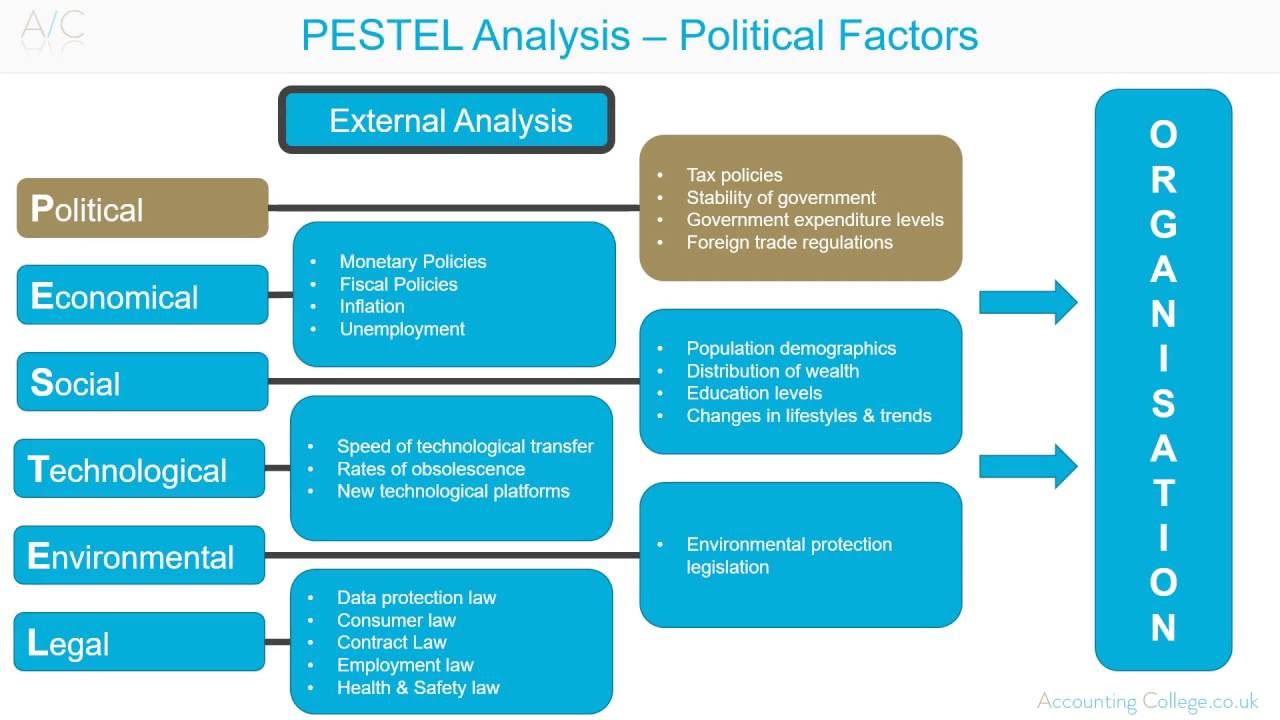
Below is a more extensive listing: